
Clinic Interior Design & Fit-Out Contractor in Singapore
A consultation room that's half a metre too narrow can stall your entire MOH licence application and most clinic owners don't discover the problem until their contractor is mid-build, the layout is locked in, and fixing it means tearing out work that's already done.
Interior design for a clinic in Singapore is fundamentally different from designing a retail shop or an office. Every square metre has to satisfy regulatory requirements from multiple agencies, support infection control, and still create an environment where patients feel at ease. This guide walks you through what matters most: compliance, clinic-type-specific design considerations, and how to choose a contractor who can handle all of it.
Why Clinic Interior Design Starts with Regulatory Compliance
Before you choose a colour palette or start browsing furniture catalogues, the real starting point for any clinic renovation in Singapore is understanding the regulatory framework your space must satisfy.
All private medical clinics need to be licensed under Singapore's Private Hospitals and Medical Clinics Act. In practice, MOH sets out facility standards covering room dimensions, waiting areas, consultation room privacy, handwashing facilities, and clinical waste storage. If your space doesn't meet these requirements, your licence application stalls — and you can't open your doors.
That means your interior design layout is shaped by compliance before aesthetics ever come into play. For example, consultation rooms must provide both acoustic and visual privacy. Clinical areas must be clearly separated from waiting and administrative zones. These aren't suggestions from a design magazine — they're conditions that MOH expects to see in place.
Beyond MOH: The Other Agencies You'll Need to Satisfy
MOH is the most obvious regulatory body, but it's far from the only one. Depending on your clinic type and the scope of your renovation, you may also need approvals from:
SCDF (Singapore Civil Defence Force): Any renovation that changes the internal layout of a commercial premises typically requires fire safety approval. Your design needs to include compliant fire doors, emergency lighting, and exit signage under Singapore's fire safety regulations.
BCA (Building and Construction Authority): Renovation works involving hacking, structural changes, or M&E modifications usually require a permit and the involvement of a Qualified Person. This comes up frequently for clinic fit-outs in shophouses or older commercial buildings.
NEA (National Environment Agency): Dental clinics with radiography equipment must meet radiation shielding requirements for X-ray rooms. More on this below.
The takeaway is straightforward: your designer and contractor need to understand these overlapping requirements from Day 1. Retrofitting compliance into a completed design is where budgets blow out and timelines slip.
Interior Design for Clinic in Singapore: What Changes by Clinic Type
A GP clinic, a dental surgery, an aesthetic practice, and a physiotherapy centre all fall under the broad category of "clinic." However, their design requirements diverge significantly. Here's what to consider based on your speciality.
GP Clinics
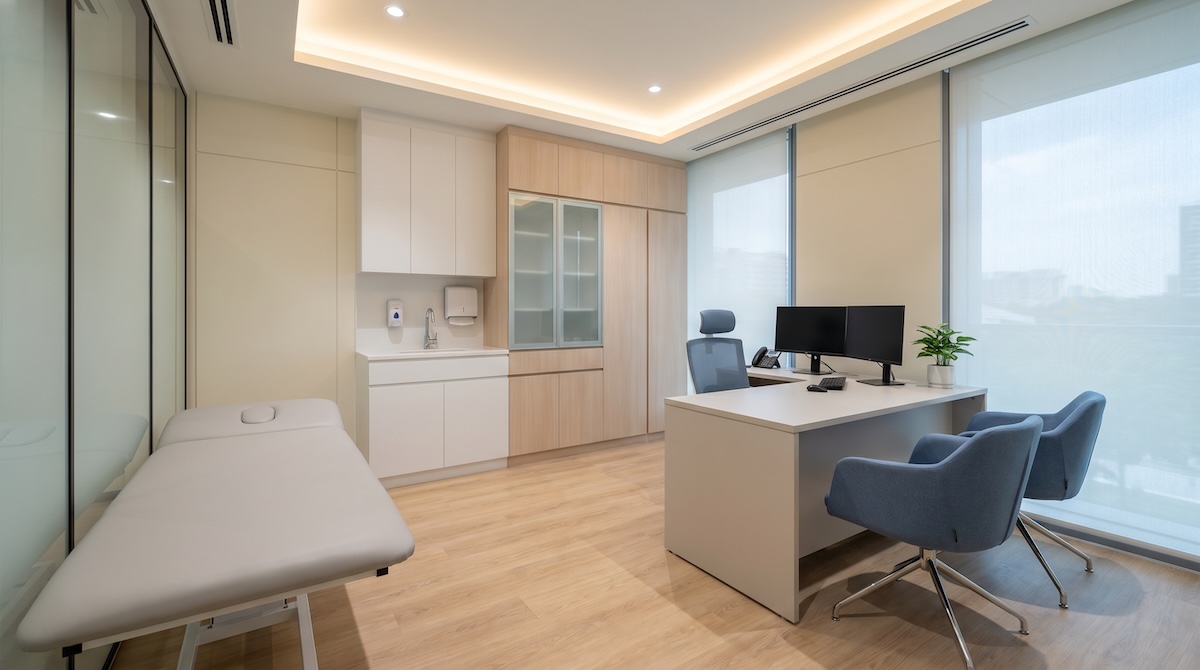
GP clinic fit-outs are the most common in Singapore, but they still demand careful planning. The layout needs a clear patient flow: entrance, registration and waiting, consultation, and exit. Consultation rooms need to be sized to accommodate an examination couch, a desk, seating for the patient, and a handwashing station.
Infection control principles apply here as well. Hard, non-porous surfaces like vinyl flooring and solid surface countertops are standard. Coved skirting eliminates dirt traps at floor-wall junctions. Hands-free taps reduce cross-contamination risk. These specifications align with MOH's infection control expectations for healthcare facilities, and they influence material selection throughout the space.
Dental Clinics
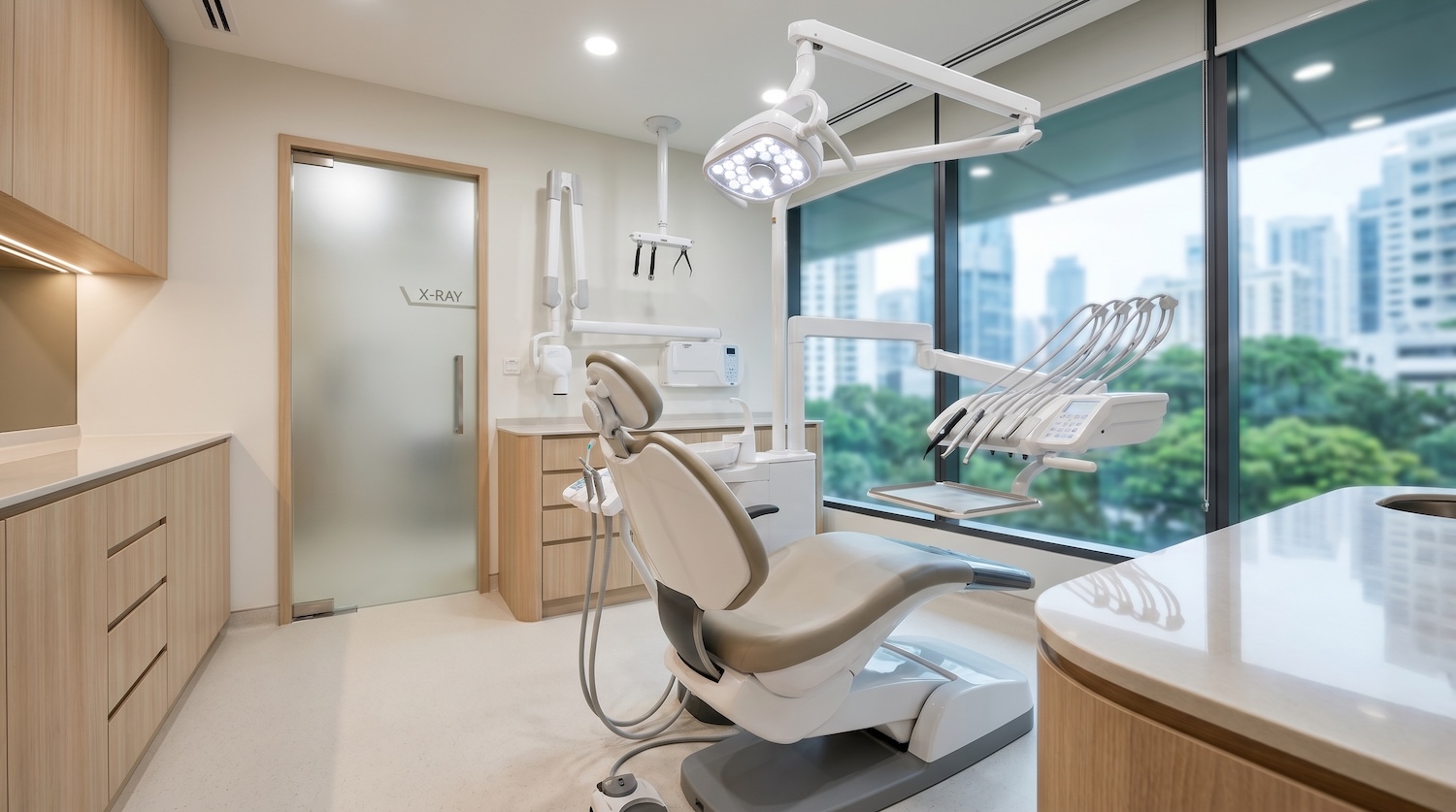
Dental clinic interior design in Singapore carries additional complexity because of radiography. Under Singapore's radiation protection regulations, dental clinics with X-ray equipment must meet NEA requirements for X-ray room shielding — which typically means lead-lined walls. This has to be factored into your renovation design and structural works before fitting out any dental chair bay with radiography equipment.
Beyond radiation shielding, dental clinics also need plumbing infrastructure for each dental chair (water supply, suction, compressed air), strong overhead lighting at each station, and cabinetry designed for sterilisation workflows. The sterilisation area should ideally follow a clean-to-dirty flow so that contaminated instruments move in one direction only.
For these reasons, dental clinic renovations often involve M&E modifications significant enough to require BCA permits and a Qualified Person.
Aesthetic Clinics
A common misconception is that aesthetic clinics operate under lighter regulations. That's not the case. MOH classifies aesthetic clinics offering procedures such as lasers, injectables, and chemical peels as medical clinics. They must meet the same facility licensing standards as GP clinics, including specific requirements for treatment room sizes and infection control infrastructure.
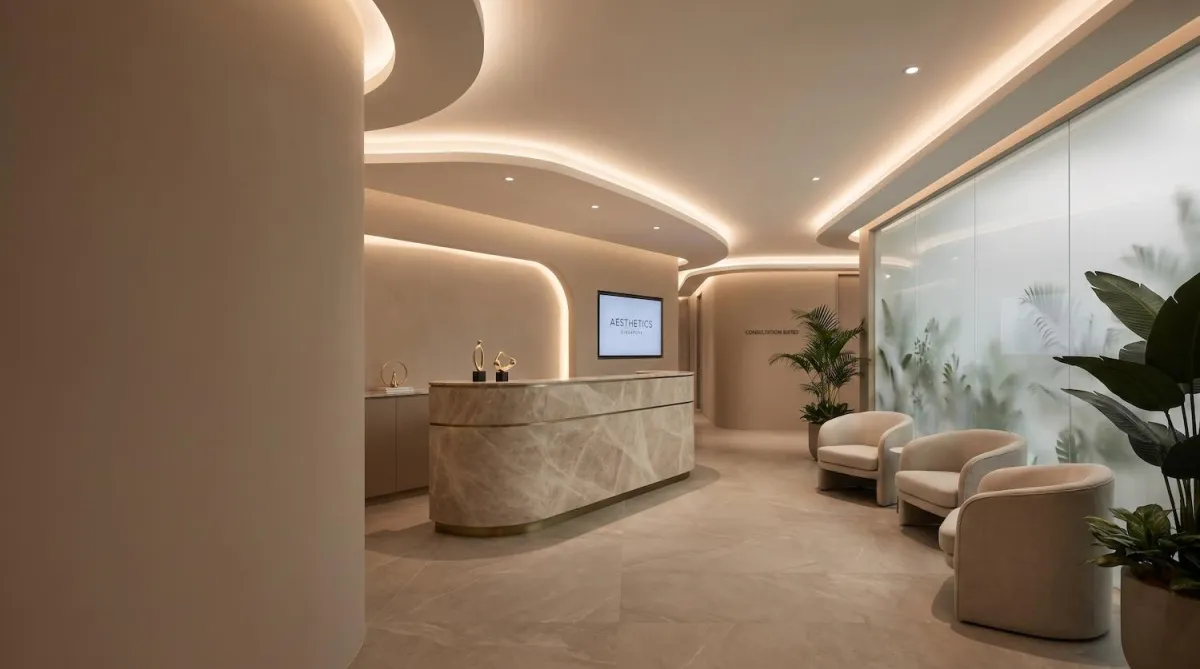
Aesthetic clinic renovation in Singapore also involves design choices that support both clinical function and patient experience. Treatment rooms often require negative pressure or HEPA-filtered ventilation, particularly where laser procedures generate airborne particulates. At the same time, the reception and waiting areas carry greater weight in terms of brand impression, since the patient demographic tends to be more design-conscious.
Balancing clinical compliance with a high-end aesthetic takes careful material selection and space planning. It's achievable, but only when the design team understands the clinical requirements as well as they understand the look and feel.
Physiotherapy and Rehabilitation Clinics
Physiotherapy clinic designs move in a different direction entirely. These spaces typically require open-plan gym or exercise zones with sufficient ceiling height for equipment clearance. BCA's Approved Document sets a general minimum ceiling height of 2.4 metres for rooms and spaces. International health facility guidelines — such as those from the International Health Facility Guidelines (iHFG) — use 2.7 metres as the standard default ceiling height across most healthcare facility areas, including patient accommodation, treatment areas, offices, and support spaces. Higher ceilings of 3.0 metres are recommended specifically for critical care areas such as ICU, CCU, HDU, and resuscitation rooms. Confirming the appropriate ceiling height for your specific equipment and layout during the design phase is essential. In addition, specialised flooring such as sprung or rubber matting is standard in rehabilitation areas to support safe movement and impact absorption.
Accessibility is also non-negotiable. Under BCA's accessibility requirements for built environments, these clinics need ramp access, accessible toilets, and obstacle-free corridors for wheelchair and mobility-aid users. While all clinics should consider accessibility, physiotherapy and rehabilitation spaces serve a patient population that depends on it.
Design Decisions That Affect Your Clinic's Daily Operations
Regulatory compliance sets the floor for your design. What elevates it is thoughtful planning around how your clinic actually operates day to day.
Patient Flow and Zoning
The path a patient takes from the front door to the consultation room, treatment area, and exit should be intuitive and minimise backtracking. Good zoning also keeps the waiting area separate from the clinical zone, which serves both privacy and infection control goals. For multi-doctor clinics, this means planning corridors and shared spaces that prevent bottlenecks during peak hours.
Storage and Back-of-House
Storage is one of the most underestimated elements in clinic design. Pharmaceutical storage, medical consumables, personal protective equipment, patient records (if physical), and clinical waste all require dedicated, compliant storage. Clinical waste, for example, must be stored in a designated area that's separate from patient-facing spaces. Designing this into the layout from the start avoids awkward workarounds later.
Lighting and Ventilation
Clinical areas need bright, even lighting that supports accurate examination and procedures. Waiting areas, on the other hand, benefit from warmer, softer lighting that reduces patient anxiety. Ventilation must meet both occupant comfort requirements and infection control standards. As a result, treatment rooms handling aerosol-generating procedures may need enhanced ventilation systems.
Future-Proofing
Lease cycles in Singapore commercial spaces typically run two to three years for most SMEs and smaller tenancies, though larger spaces or tenants with long-term plans may secure terms of four to six years. If your clinic might expand services, add practitioners, or reconfigure treatment rooms during that period, it's worth designing flexibility into the layout now. That might mean oversized conduit runs for future cabling, modular partition walls, or treatment rooms that can be repurposed without major structural work.
Speaking of leases — if you're fitting out a space you don't own, it's smart to understand your reinstatement works obligations from the start. Some landlords require you to restore the unit to its original condition at end of tenancy. Knowing this upfront can influence design choices, such as whether to build permanent walls or use demountable partitions.
What to Look for in a Clinic Renovation Contractor
General renovation experience alone isn't enough for clinic projects. You need a contractor who combines turnkey capability, regulatory knowledge, and a proven track record with MOH-licensed fit-outs.
Choosing the right contractor is arguably the most consequential decision in your clinic renovation. The wrong choice leads to cost overruns, failed inspections, and delayed openings. The right choice gives you a single point of accountability from design through to handover.
Turnkey Capability
For clinic renovations in particular, a turnkey approach offers significant advantages. A commercial renovation contractor in Singapore that handles design, regulatory submissions, construction, and M&E in-house eliminates the coordination risk that comes with managing separate vendors. When your designer, contractor, and M&E engineer work under one roof, compliance issues get caught in the design phase rather than during the build.
Regulatory Experience
Ask directly: has the contractor handled MOH-licensed clinic fit-outs before? Do they know the submission process for SCDF fire safety approvals? Can they coordinate with a Qualified Person for BCA permits? A contractor who has navigated these processes before will build realistic timelines and avoid surprises that delay your opening.
3D Visualisation Before Build
Seeing your clinic layout in 3D Modelling before construction begins allows you to validate patient flow, check room proportions, and confirm that the design supports your operational workflow. This step prevents costly mid-build changes and gives you confidence that the finished space will match what was planned. Working with a firm offering commercial interior design services in Singapore that includes visualisation as part of the design process can save significant time and cost downstream.
Track Record and Accountability
Request past project examples. Ask about timeline adherence and budget accuracy. A contractor confident in their delivery will be transparent about both. The clinic renovation space in Singapore is specialised enough that general renovation experience alone won't cut it.
Getting Your Clinic Interior Design Right the First Time
Interior design for a clinic in Singapore sits at the intersection of healthcare compliance, functional design, and patient experience. Getting it right requires a team that understands all three — not just one.
Whether you're planning a GP clinic fit-out, a dental surgery build, or an aesthetic clinic renovation in Singapore, the path to a smooth project starts with the right partner. One who can take your requirements, navigate the regulatory landscape, and deliver a space that's ready for patients on the day you planned to open.
Frequently Asked Questions
Q: How long does a clinic renovation in Singapore typically take from start to finish?
Timeline depends on clinic type and scope of works, but most clinic fit-outs take between eight and sixteen weeks from design sign-off to handover. Complex builds involving structural changes, BCA permits, or dental X-ray room shielding can extend beyond this. Regulatory submission timelines with MOH and SCDF are a key variable.
Q: Do aesthetic clinics in Singapore need to meet the same MOH standards as GP clinics?
Yes. MOH classifies aesthetic clinics offering procedures such as lasers, injectables, and chemical peels as medical clinics. They're subject to the same facility licensing standards as GP clinics, including minimum treatment room sizes, infection control infrastructure, and handwashing facilities.
Q: Can I use demountable partitions instead of permanent walls in my clinic fit-out?
Demountable partitions are a viable option and can simplify reinstatement at the end of your tenancy. However, they must still meet MOH requirements for acoustic and visual privacy in consultation and treatment rooms. Your designer and contractor should confirm that any partition system satisfies both the landlord's reinstatement expectations and the clinical privacy standards required for licensing.
Q: Which regulatory bodies need to approve a clinic renovation in Singapore?
Most clinic renovations require sign-off from MOH for facility licensing, SCDF for fire safety if the internal layout changes, and BCA if structural or M&E works are involved. Dental clinics with X-ray equipment also need NEA compliance for radiation shielding. Engaging a contractor experienced with all four agencies from the outset prevents delays caused by missed submissions.
If you're at the planning stage and want to understand what your specific clinic type requires, get a consultation for your clinic renovation. Call 8368 5194 or email go@contract.builders to discuss your project with the Contract Builders team.